

As an instructor of online and blended courses, I was recently sent (by an administrator concerned with such things) a “Compliance Audit” policy used by another college, for review. The audit form consists of several pages where instructors are asked to describe and quantify what happens in their courses in various ways.
But what can be ascertained with this process? Though the audit provides a veneer of quantifiability, it’s hard to imagine how anything an instructor might put into such an Audit Form would be verifiable in any way. In fact, I don’t think “audit” is an accurate term; it’s more like a rough projection, a series of estimates of how much time different activities might take. It could be complete fiction — who would know?
Though it was sent to me to solicit my thoughts because of my involvement with online pedagogy at my school, ostensibly these audits would be completed for all courses and delivery modes, traditional as well as online or blended. This is only fair; requiring audits for one mode but not another wouldn’t be equitable. Still, it seems to me that such initiatives are mostly inspired by a desire to better monitor online and hybrid offerings.
From what I’ve seen, although they’re wont to say things like “We need to do more online!”, a lot of administrators are suspicious of such activities, feeling sure that it’s yet another way for faculty to slack off, scam the system.
This is puzzling to me. Having done classes in all modes — face-to-face, hybrid/blended, and online — I believe it’s much easier for a supervisor to know what’s being done in blended and online classes than in F2F classes.
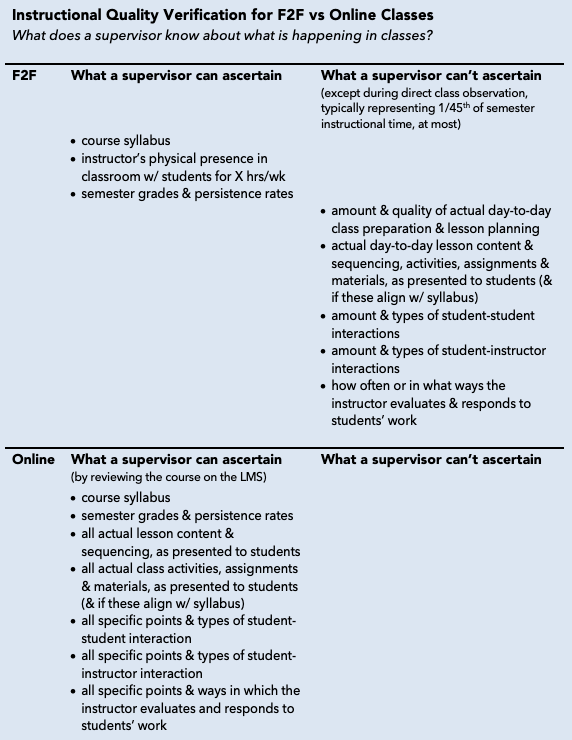
In the case of F2F classes, what can a supervisor generally know about a specific class section? Not much, usually: (a) that the instructor has a syllabus, and (b) that the instructor is physically present in a room with students for X hours per week. Apart from the occasional, brief class observation (very occasional in the case of tenured faculty) or perhaps walking past an open door or lurking in the hallway, a supervisor has no way to ascertain what happens in the class: the amount and quality of preparation and lesson planning, the actual class activities and assignments and materials used (and if these align with the syllabus), the interaction between students and instructor, how often or in what ways the instructor evaluates and responds to students’ work, and so on.
I can tell you from 35 years of experience: it’s easy for F2F-only instructors to slack off in any and all of the above-mentioned areas without anyone knowing or particularly caring. In many/most cases, their colleagues and supervisors know exactly who these people are, but no one does anything.
For online and blended courses, on the other hand, if supervisors are able to review the course on the LMS — and I think they should be able to do this, just as they request detailed syllabi for F2F classes — then they can see concrete evidence of all of the above: the quality and appropriateness of lesson content and sequencing, the actual activities and assignments and materials used, specific points and types of student-student and student-instructor interaction, and specific ways in which the instructor is evaluating and responding to student work.
Here’s the above in a table:
If we’re concerned with verifying the quality of instruction, there’s no reason to single out the non-traditional approaches; attention should be placed on devising ways of better monitoring both F2F and online/blended courses equally. The level of scrutiny and verification placed on one mode should not differ substantially from that placed on other modes.
The larger question is: What’s the best way to go about ensuring educational quality?
If the goal is to fill gigantic binders (real or virtual) with documents that no one will ever read or pay any attention to once filed away, then I think the “Compliance Audit” approach is ideal.
But if the goal is to truly ensure consistency and quality in courses, such exercises are of little or no value. The best approach, I believe, involves hiring good and qualified faculty, ensuring that they work collaboratively, providing them with guidance and opportunities for professional development, and having faith in their abilities and professionalism. And then having some oversight procedures which are not unnecessarily intrusive or cumbersome (for either the supervised or supervisor) and which are equitable across modes.
Why am I thinking about these things? Well, in the process of keeping detailed notes on my experience with my hybrids and online courses for the past several terms, I’ve discovered two things: First, quantifiable results from the courses have been very positive as regards student engagement and persistence. Students have succeeded at rates equal to or a bit higher than my traditional classes, and have expressed satisfaction with the blended and online modes. Second, my own time on task to make these classes work has been much higher than for traditional classes, to the extent that I’d say it’s close to unsustainable. So it’s pretty galling to think that this teaching mode might be singled out for extra scrutiny based on the supposition that it’s a way to shirk one’s obligations.
That said, I know of cases of faculty who have set up online courses that generate considerable income for them while requiring very minimal effort or interaction with students. This of course is unprofessional and unethical, though as mentioned above, the same thing can occur in F2F classes. Efforts should be made to prevent this from happening regardless of the instructional mode.
In the end, as so often happens in the academic world, nothing ever came of this “Compliance Audit” business. I never brought it up again, and neither has the administrator who sent it to me.
 l i t w i c k i p e d i a